An AI SEO agent that works from your real search data
Good search engine optimization starts with evidence: what people search for, what your pages rank for today, and which pages bring visitors who become customers. Reach Them AI gives you an AI SEO agent that pulls that evidence from Semrush, Google Search Console, Google Analytics, and a live crawl of your site, then turns it into specific changes. New title tags, better meta descriptions, rewritten page sections, and a list of pages to create.
Research is read-only. Page edits wait until you approve the exact change.
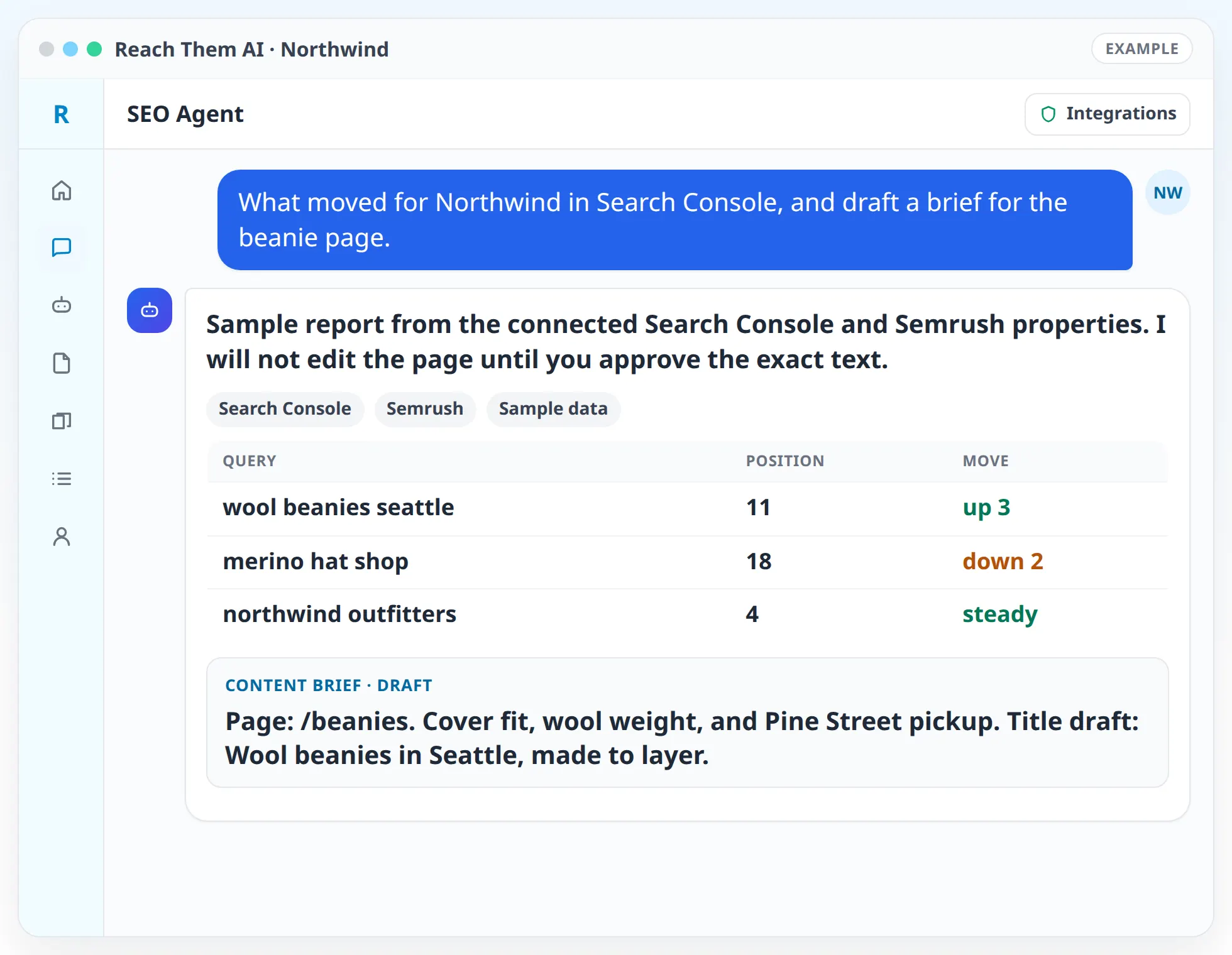
Each recommendation shows its source. When the data is not there, the agent tells you what it needs rather than filling the gap with a guess.
What the SEO agent does
- Keyword research. The agent finds the searches your customers use, with volume and difficulty from Semrush, and groups them by the page that should rank for each group.
- Site audits. Using Firecrawl, it reads your pages the way a search engine does and reports missing titles, duplicate descriptions, thin pages, broken internal links, and pages with no clear topic.
- Search Console analysis. It finds queries where you show up on page two, pages with lots of impressions and few clicks, and pages that lost traffic recently.
- On-page rewrites. It drafts title tags, meta descriptions, headings, and body copy for the pages that matter most, then runs a humanizing pass so the copy reads like a person wrote it.
- Content planning. It lists the pages and articles you are missing compared with the competitors that rank for your terms.
- Local search. With the Local SEO Agent, it builds city and service keyword sets, writes Map Pack briefs, and drafts location pages that avoid thin, copy-paste content.
- Rank tracking. When your Semrush account has position tracking set up, the agent reads your rankings and explains what moved and why it might have moved.
How it works, step by step
- 01
Connect your data. Semrush is the main source. Search Console, Google Analytics, and Firecrawl fill in what Semrush cannot see. Treg is an optional extra source for SERP and backlink data.
- 02
Name the goal. "Get more calls from the service pages," "rank for emergency plumber in Tampa," or "find out why traffic dropped in March." One goal per conversation keeps the work focused.
- 03
Get the evidence. The agent pulls the relevant data and shows you what it found before it recommends anything.
- 04
Review the plan. You get a short list of changes ranked by likely impact and effort, each with the page, the current text, and the proposed text.
- 05
Approve and publish. Copy the new text into your site, or let a site agent apply it. On Shopify, the agent can update product SEO titles and descriptions after you confirm each change.
- 06
Measure. A scheduled automation can check Search Console each week and report on the pages you changed.
Integrations the agent uses
 Semrush
Semrush for keywords, competitors, backlinks, and position tracking
 Google Search Console
Google Search Console for queries, clicks, impressions, average position, and indexing
 Google Analytics
Google Analytics for engagement and conversions by landing page
 Firecrawl
Firecrawl for crawling and reading live pages, yours and competitors'
 Shopify
Shopify for product and collection SEO fields
 Wix
WixWix for page-level SEO drafts on Wix sites
 Google Docs
 Google Sheets
Google Docs and Google Sheets for briefs, audits, and keyword maps
What you approve before anything goes live
Research and audits are read-only, so the agent runs them freely. Changes are different. The agent shows you the exact before and after text and waits for your approval before it edits a Shopify product or a Wix page. For other website platforms, it gives you the copy and you publish it.
Scheduled SEO checks only read data and send you a report unless you turn on live actions for that automation.
How the agent avoids made-up SEO numbers
A common problem with AI-written SEO advice is invented search volumes and rankings. The SEO agent is built to cite a source for every number: Semrush, Search Console, Google Analytics, or a crawl it ran. If a source is not connected or is out of API units, the agent says so and shows what it could do without that data.
Who this is for
- Small businesses that want SEO help grounded in their own Search Console data
- Ecommerce stores on Shopify that need product titles and descriptions improved at scale
- Local service companies that want to rank in the Map Pack and for city plus service searches
- Marketing teams that want a second analyst for audits and briefs
- Agencies running SEO for several clients that need repeatable, sourced reports
Agent templates for SEO
Related services
FAQ
What do I need to connect for the SEO agent?
Semrush, Firecrawl, Google Search Console, and Google Analytics. You connect your own accounts on the Integrations page. Treg is optional for extra SERP and backlink data.
Can the agent make changes to my website?
On Shopify it can update product SEO titles and descriptions after you approve each change. On Wix it prepares SEO drafts for you to apply. On other platforms it writes the copy and you publish it.
Does the agent track my rankings?
It reads rankings from Semrush position tracking when your Semrush account has it set up, and it uses Search Console for average position by query and page.
How is this different from an SEO tool?
SEO tools show data. The agent reads the data from several tools at once, decides what matters for your goal, and writes the actual title, description, or page copy you need, with the source for each recommendation.
Does the agent help with local SEO?
Yes. The Local SEO Agent covers city and service keywords, Map Pack briefs, location pages, listings, and reviews.
Get an SEO plan built on your own data
Connect Semrush and Search Console, name one goal, and the agent will come back with evidence and a ranked list of changes.