What Is a Forward Deployed Engineer? A Guide for Business Owners
Forward deployed engineers build AI inside a customer's business. Learn what FDEs do and earn, and how to get the same help without a $200,000 full-time hire.
On June 30, 2026, Amazon Web Services put $1 billion behind a job title. Two days later, Microsoft launched a $2.5 billion business built around roughly 6,000 experts who work inside customer companies. What are they betting on? The forward deployed engineer. On October 8, OpenAI alone had 26 openings for it on its careers page.
AI models are easy to buy and hard to put to work. Someone has to wire them into a company's real data and tools, then stick around until the system runs every day. This guide covers what a forward deployed engineer (FDE) is, where the job came from and what it pays. Own a business and weighing AI agents? The second half shows how to get the same kind of help without hiring a $200,000 engineer.
What is a forward deployed engineer?
A forward deployed engineer (FDE) is a software engineer who works inside a customer's business, rather than at the vendor's office, to build and launch software on that customer's real data and systems. Palantir created the role. OpenAI, Anthropic and AWS now use FDEs to get AI agents into production.
Key takeaways
An FDE writes production code inside the customer's systems and stays after launch. Solutions engineers mostly help close the sale. Consultants mostly advise.
Palantir invented the job and nicknamed these engineers "Deltas." Until 2016, it employed more of them than regular software engineers.
Demand jumped with AI. Indeed's index of FDE job postings was up roughly 729% year over year as of April 2026, and AWS and Microsoft have committed billions to embedded engineering teams.
The pay is steep. OpenAI's current U.S. FDE postings list base pay of $185,000 to $300,000, which puts a full-time hire out of reach for most small and mid-sized companies.
You can get the same working style from an AI agent implementation partner that builds inside your own tools, measures results and hands over what it built.
Prefer to watch? This short video explains why the role exists. Most companies have already bought AI tools, but very few have an AI agent actually running in their business. The FDE is the person who closes that gap.
What does "forward deployed" mean?
The name is borrowed from the military. Being "forward deployed" means being stationed close to where the work happens instead of back at headquarters. So an FDE is an engineer the vendor sends into a customer's business to make its product work there. In practice, that means sitting with the customer's team (in person or remotely), learning how the business runs and writing the code that connects the product to it.
Forward deployed engineers build AI inside a customer's business. Learn what FDEs do, what they earn, and how to hire an AI agent team that works this way.
The definition most people quote comes from Palantir. On its engineering blog, Palantir put the difference between its product engineers and its FDEs this way: a product engineer's focus is "one capability, many customers," while the FDE's is "one customer, many capabilities" (Palantir Blog, "Dev versus Delta").
Where the role came from: Palantir's Deltas and Echos
Back in the early 2010s, Palantir created the forward deployed software engineer role and nicknamed it "Delta" (The Pragmatic Engineer, August 12, 2025). Why Delta? In the company's early days, each business development team was named after a letter of the NATO alphabet. Deltas sat in business development. Their mandate, in Palantir's words, was "to achieve technical outcomes for our customers" (Palantir Blog). And the model was central to the company: until 2016, Palantir had more Deltas than regular software engineers (The Pragmatic Engineer, 2025).
Deltas rarely worked alone. They were paired with Deployment Strategists, known internally as "Echos." By the company's own description, Echos lean toward product management and Deltas are more technical, though "the lines between the two roles blur heavily quite often" (Palantir Blog, "A Day in the Life of a Palantir Deployment Strategist").
That pairing still makes sense — one person understands the business problem and the people involved, and the other builds the system. We think it's the right way to staff an AI agent project, too.
Palantir paired engineers ("Deltas") with deployment strategists ("Echos").
What does an FDE actually do?
An FDE owns the path from a customer problem to working software in production. Details change by company. The loop mostly doesn't:
Discovery: Sit with the people who do the work, find the problem worth solving and agree on how success will be measured.
Access: Get into the systems that matter (the CRM, inbox, phone system, databases and internal tools) with the right permissions.
Build: Write the integrations, data pipelines and application code on the customer's real data.
Testing: for AI systems, that means evals: repeatable tests that show whether the model is accurate enough to trust with real work.
Launch and support: Ship it, watch how people use it, fix what breaks and keep improving it.
Product feedback: Report patterns from the field to the vendor's product team, so the next customer gets a better product.
In AI work, the deliverables have gotten very specific. Anthropic's FDE posting asks engineers to "work within customer systems to build production applications with Claude models." It wants "MCP servers, sub-agents, and agent skills that will be used in production workflows." It also expects 25% to 50% travel to customer sites (Anthropic).
What separates an FDE from a contractor? Product feedback. Take OpenAI. Its FDEs, working with a call center customer, built evals for a voice model that wasn't yet good enough to deploy. They took the data back to OpenAI's research team, the model improved, and that customer became the first to put it into production, with the improvements reaching every customer through OpenAI's Realtime API (The Pragmatic Engineer, 2025). The same team also contributes to OpenAI's Agents SDK.
Mukul Saha, a senior director analyst at Gartner, summed up how this differs from older roles: "A true FDE is typically expected to go further into implementation, working alongside the customer from problem discovery through building and production deployment, while also feeding what they learn back into the core product" (IT Brew, October 1, 2026).
Why is everyone hiring FDEs right now?
Most AI projects stall somewhere between a promising demo and daily use. FDEs are paid to close that gap.
The numbers are rough. In 2025, MIT's NANDA initiative reported that about 95% of the organizations it studied were getting no measurable profit-and-loss return from their generative AI pilots (Fortune, reporting on MIT's "The GenAI Divide: State of AI in Business 2025", August 18, 2025). Gartner wasn't more hopeful. It predicted in June 2025 that more than 40% of agentic AI projects will be canceled by the end of 2027, citing rising costs, unclear business value and weak risk controls (Gartner, June 25, 2025).
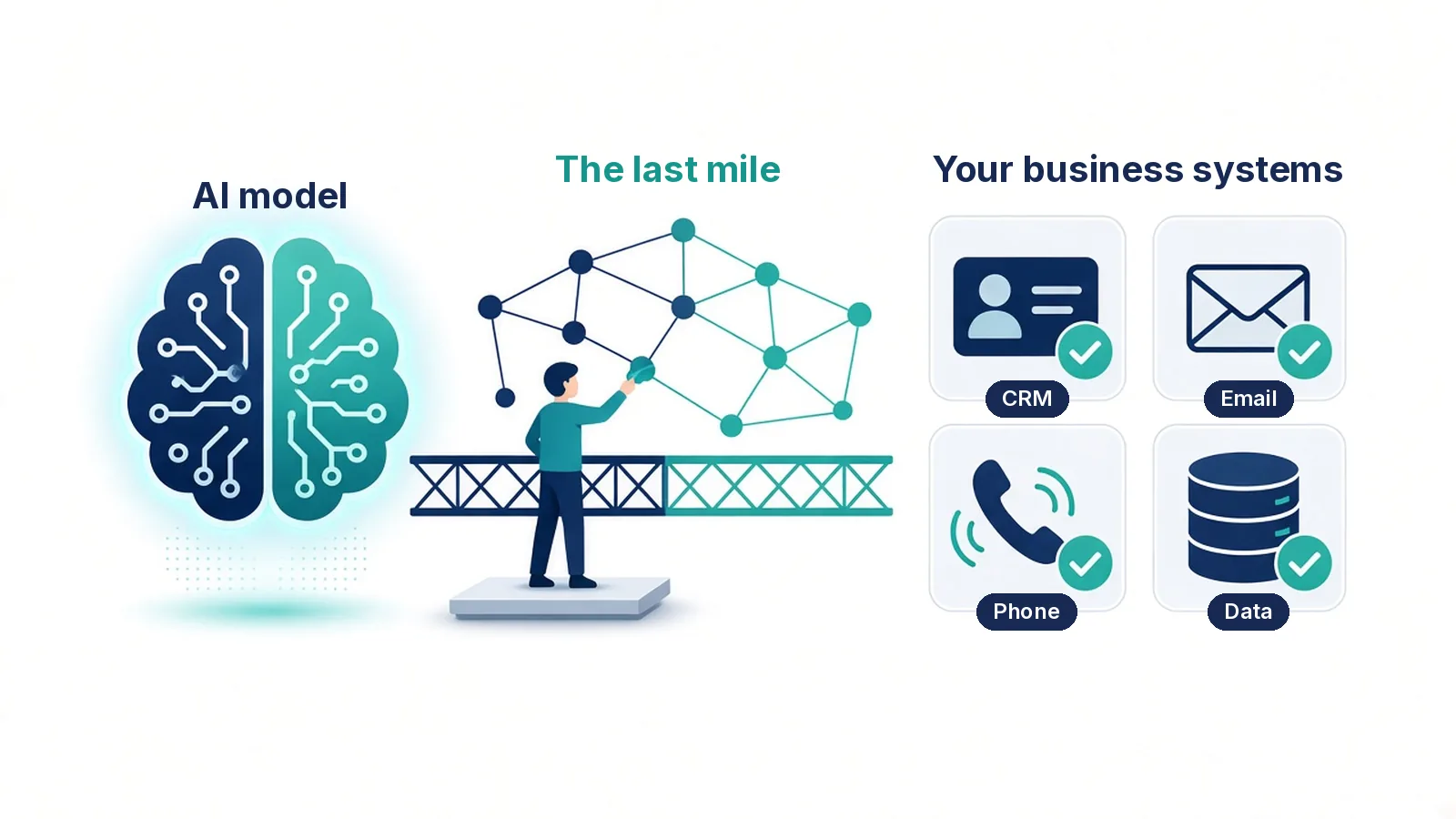
The "last mile" is the work of connecting a capable model to the systems a business already runs on.
Andreessen Horowitz called the FDE "the hottest job in startups" in June 2025. It compared enterprise AI buyers to "your grandma getting an iPhone": they want to use it, but someone has to set it up (a16z, "Trading Margin for Moat", June 2025). At the time, 22 of the 311 open roles on OpenAI's careers page were forward deployed or solutions engineering jobs.
Job postings show the same jump:
FDE listings rose more than 800% between January and September 2025, according to Indeed Hiring Lab data reported by the Financial Times (Financial Times).
By April 2026, Indeed's index of FDE postings stood 5,230% above its January 2025 level. That's roughly 729% higher than a year earlier. Business Insider notes these are index values against a January 2025 baseline, not raw posting counts (Business Insider, May 16, 2026).
On October 8, 2026, we counted 26 roles with "forward deployed" in the title out of 816 openings on OpenAI's public careers board. Anthropic's listed 6.
Then the cloud giants moved. AWS created a Forward Deployed Engineering organization backed by $1 billion to "embed thousands of experts with customers to co-develop and deploy agentic AI solutions" (About Amazon, June 30, 2026). Microsoft launched Microsoft Frontier Company with $2.5 billion and about 6,000 embedded experts (Microsoft, July 2, 2026). And Google Cloud? Its CEO said in May 2026 that it was hiring for the role as well (Business Insider, 2026).
Not everyone's convinced. Some argue the title is partly a new label for solutions and integration engineering, a point Wikipedia attributes to a16z, which called it "title arbitrage" (Wikipedia, retrieved October 8, 2026). Either way, the useful test is simple. Does the person write and own production code for the customer?
Forward deployed engineer vs. solutions engineer vs. software engineer vs. consultant
Short version: an FDE builds and owns the working system inside one customer's business. A solutions engineer helps win the deal. A product software engineer builds features for every customer, and a consultant advises.
FDE: The job is making the product work inside one customer's business. FDEs write production code in that customer's systems, arrive after the contract is signed and stay through launch and beyond. Success is measured by the customer's result in production, and after launch they still own the system and keep improving it.
Solutions engineer / architect: Mostly a pre-sale role. This person designs the solution and helps close the deal; the code is usually demos and prototypes, rarely production. They're judged on the technical win and deal size, and they don't own anything after launch.
Software (product) engineer: Builds features for all customers from inside the vendor, on an ongoing basis, in the core product. Product quality and speed are the yardsticks. After a launch, the only thing this engineer owns is the product itself.
Consultant: Hired for a defined project to analyze and recommend. Production code? Usually not. Consultants are measured on deliverables and hours, and the work isn't theirs to own after launch.
OpenAI draws the line between its own solutions architects and FDEs in the same place. Its FDEs are more hands-on and "write code directly on customer infrastructure" (The Pragmatic Engineer, 2025).
For business owners, this comparison is also a buying guide. Some firms selling "AI agents" work like consultants: they run a workshop, hand over a slide deck or a prototype, and leave. Look for one that works like an FDE.
This video goes deeper on how an FDE differs from a consultant and a solutions architect, including how OpenAI scopes, validates and delivers these projects.
How much do forward deployed engineers make?
In the U.S., well into six figures. Recent sources:
OpenAI's U.S. FDE postings list base pay of $185,000 to $300,000 plus equity. For its Forward Deployed Software Engineer role in San Francisco, the range is $185,000 to $325,000 (OpenAI careers, retrieved October 8, 2026).
Over at Anthropic, the London FDE posting lists £225,000 to £255,000 (Anthropic, retrieved October 8, 2026).
Indeed puts pay for the role at about $170,000 to over $200,000 (Business Insider, May 2026).
That's salary alone. Benefits, recruiting costs and the months it takes to find someone all come on top. For many small and mid-sized companies, one senior FDE would cost more each year than their entire AI budget.
Why businesses hire forward-deployed AI agent teams instead of an FDE
Most small and mid-sized businesses don't need a full-time FDE. What they need is the FDE way of working, applied to one or two AI agent projects that matter: answering leads, booking appointments, following up on quotes, triaging the inbox or updating the CRM.
An outside team can also raise your odds. MIT's 2025 study found that AI tools bought through partnerships with specialized vendors reached deployment about 67% of the time. Systems that companies built entirely in-house got there about 33% of the time (Fortune, August 2025). Its authors note the comparison rests on a small interview sample. Treat it as a signal.
A forward-deployed AI agent team should give you what the big players promise their enterprise customers, at a scale that fits your business:
An agent running on your real tools and data from the first week.
A named person who learns how your team works before building anything.
One clear metric, agreed up front (response time, booked calls or hours saved).
Testing before launch, and monitoring after it.
Documentation, prompts and access that stay with you when the project ends.
AWS describes the goal of its own program in similar terms, saying customers should leave its FDE engagements "self-sufficient" with "runbooks, architectural documentation, and trained internal champions" (About Amazon, June 2026). A small business can ask for the same thing.
What to look for in an AI agent implementation partner
Good partners work the way FDEs do. Check these six things before you sign.
Do they build inside your systems?
Ask where the agent will run and what it'll connect to. You want the work done in your CRM, inbox, phone system and data from the start, with access scoped to what the agent needs.
One outcome, one number
Keep the first project narrow: a single workflow, plus an agreed way to measure it. Be wary of anyone promising to "transform the business" in the first engagement.
Testing before launch, monitoring after
How will anyone know the agent is accurate? Expect a solid partner to walk you through their evals (test cases drawn from your real conversations or records) and to explain how they'll watch the agent once it's live.
How they handle security
Find out what data the agent can see, where it's stored, who can access it and how its actions are logged, and make sure its permissions follow the principle of least privilege.
Who's still around in week two?
Plenty of work happens after launch, so ask who fixes problems in week two, how your staff will be trained and how improvements will be handled.
You own what they build
Prompts, agent skills, integrations, documentation — all of it should belong to you. Avoid setups that leave you locked into one vendor's account.
Red flags
Demos that only run on sample data.
No production references you can call.
Vague answers about how accuracy is measured.
"Agent washing." That's Gartner's term for rebranding chatbots and automation tools as agents without real agent capabilities (Gartner, 2025).
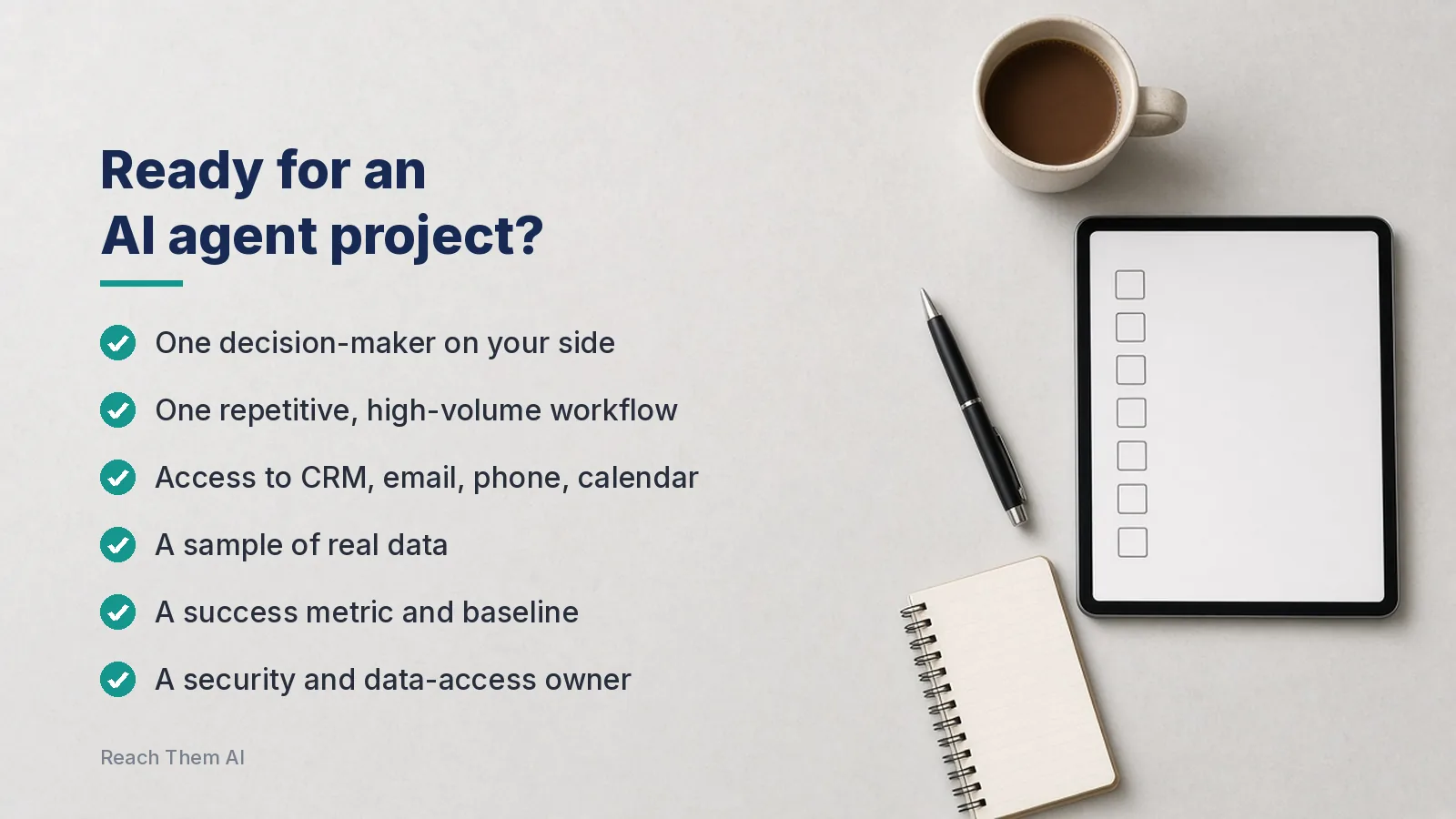
Checklist: are you ready for an AI agent project?
You're ready to bring in a forward-deployed AI agent team when you can tick most of these boxes:
One owner on your side who can make decisions and answer questions.
One high-volume, repetitive workflow to start with (new lead follow-up, say).
Access to the systems involved: CRM, email, phone, calendar or helpdesk.
A sample of real data, such as past conversations, tickets or records.
A success metric, plus today's baseline for it.
A budget range and a decision timeline.
Someone responsible for security and data access.
A plan for who on your team will use and oversee the agent.
Save this checklist for your first conversation with an implementation partner.
Only a few boxes ticked? Start with the first two. For a scoping call, a clear owner and a single workflow are enough.
Frequently asked questions
What does FDE stand for?
Forward deployed engineer: an engineer who works inside a customer's business to build and launch software on its real systems. Palantir's formal version of the title is Forward Deployed Software Engineer (FDSE). At Anthropic, FDEs sit on the company's Applied AI team (Anthropic job posting, retrieved October 8, 2026).
Is a forward deployed engineer a sales role?
No. FDEs work closely with customers, but their main job is building and running production software. Solutions engineers and sales engineers focus on the sale, while FDEs typically arrive after the contract's signed.
How is an FDE different from a solutions engineer?
It comes down to timing and ownership. A solutions engineer designs the approach and helps win the deal, usually before the sale. An FDE builds the system inside the customer's environment after the sale and stays responsible for it in production.
How much does a forward deployed engineer make?
Recent OpenAI postings in the U.S. list FDE base pay of $185,000 to $300,000 plus equity. Indeed data puts typical pay at about $170,000 to over $200,000 (October 2026 and May 2026 figures, respectively).
Is the forward deployed engineer a new role?
No. Palantir created it in the early 2010s. What's new is the scale: since 2025, OpenAI, Anthropic, AWS, Microsoft and Google Cloud have built or expanded forward deployed teams to get AI into production for customers.
Does my small business need to hire a forward deployed engineer?
Usually not. Most small and mid-sized businesses get better value from an AI agent implementation partner that works the same way: one that builds inside your tools, measures results, stays through launch and hands over what it built.
How much does it cost to build and deploy an AI agent?
It depends on a handful of things: the number of systems the agent connects to, how messy your data is, how much testing it needs, how risky its actions are and how much ongoing monitoring you want. Ask any partner to price one scoped workflow first.
Work with a forward-deployed AI agent team
Got a workflow you'd like an AI agent to handle? Contact Reach Them AI to scope the project. Bring the readiness checklist above, and we can work out which workflow to start with and which systems the agent would need to reach.
Andreessen Horowitz, "Trading Margin for Moat: Why the Forward Deployed Engineer Is the Hottest Job in Startups," June 2025. https://a16z.com/services-led-growth/